Scientific publications where Cell-ACDC was used
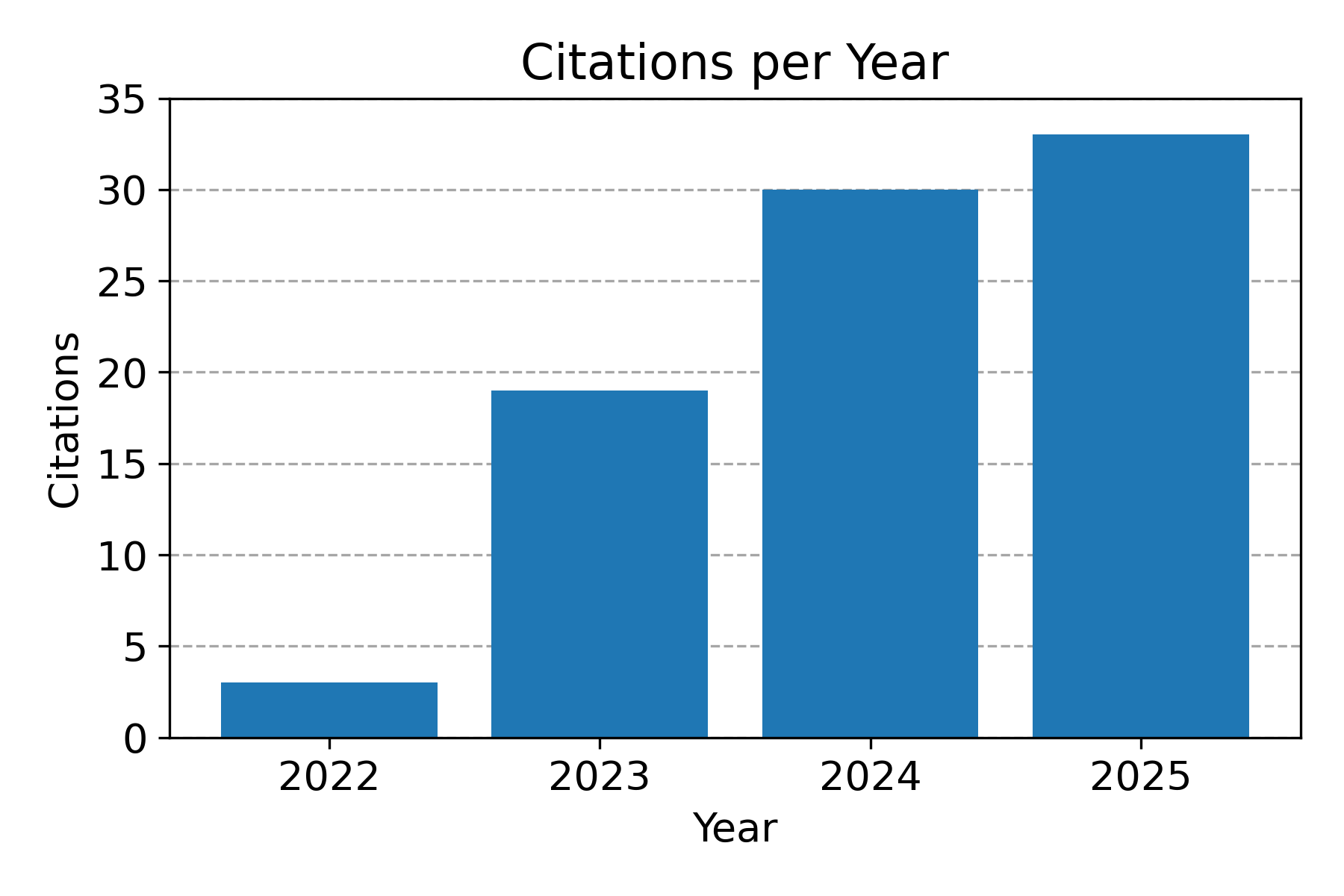
Citations per year. Data from Google Scholar.
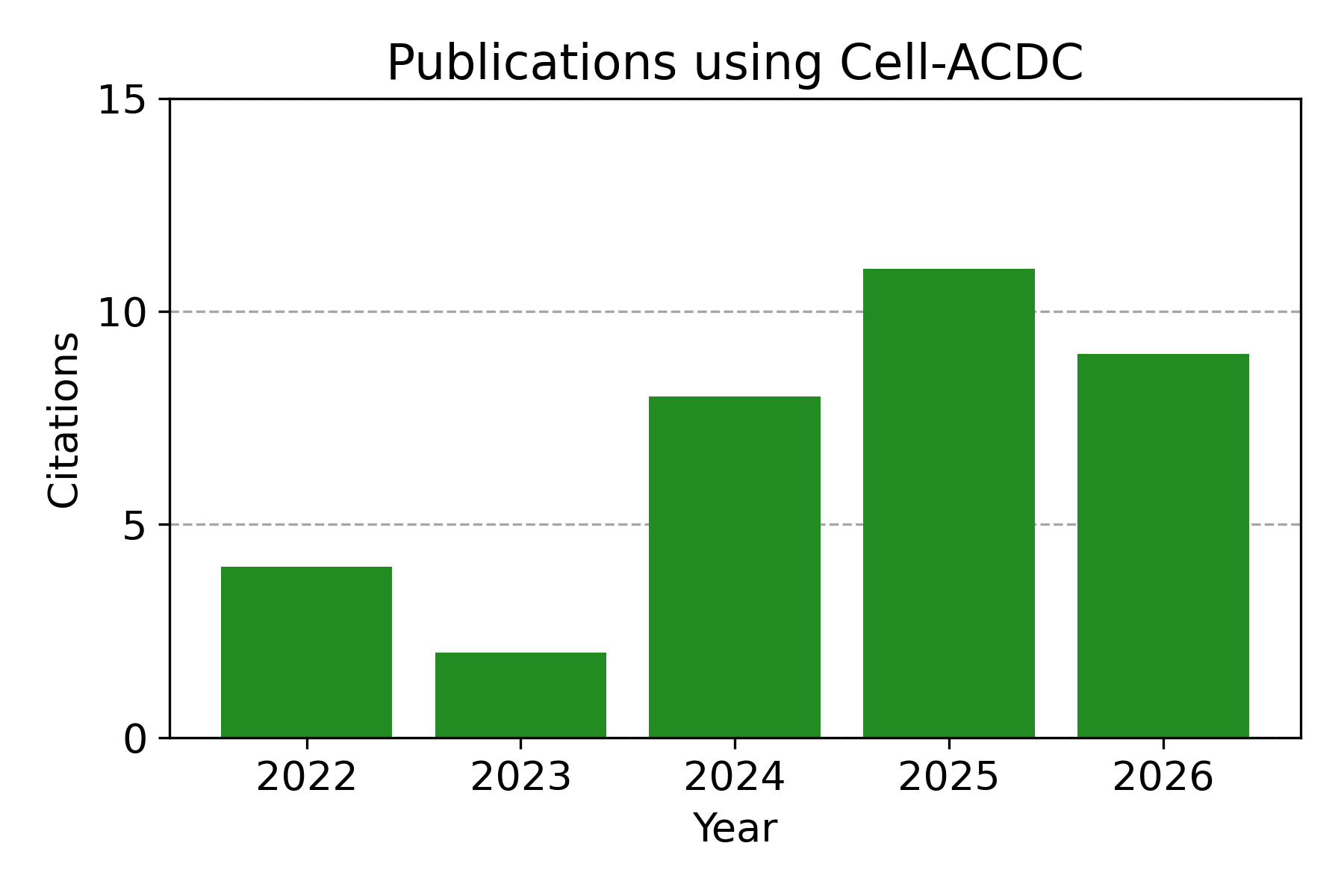
Publications that used Cell-ACDC, per year.
In the following publications, authors used Cell-ACDC to analyse microscopy data and obtain biological insights:
- Vandal, E. S., et al. The role of cell growth rate on accumulation of the mitotic cyclin Cdc13 in fission yeast. Journal of Cell Biology (2026) DOI: 10.1083/jcb.202605069.
- Adhikaryr, S., et al. Rad53/Chk2 couples mitochondrial outputs and ROS with G2/M cell cycle progression. bioRxiv (2026) DOI: 10.64898/2026.10.14.759190.
- Athar, F., et al. Glucose enrichment accelerates C. elegans reproductive aging via non-autonomous DAF-2/insulin-like receptor signaling in somatic tissues. Communications Biology (2026) DOI: 10.1038/s42003-026-10564-7.
- Muñoz-Barrera, M., et al. HLH-30/TFEB is necessary for chromatin reorganization and maintenance of cell quiescence during starvation in C. elegans. Nucleic Acids Research (2026) DOI: 10.1093/nar/gkag949.
- Dengler, L., et al. Swe1 delays cell cycle progression during impaired mitochondrial inheritance to promote mitochondrial homeostasis. bioRxiv (2026) DOI: 10.64898/2026.09.18.752582.
- Chadha, Y., et al. "Single-cell imaging reveals a key role of Bck2 in yeast cell size adaptation to nutrient challenges. Journal of Cell Biology (2026) DOI: 10.1083/jcb.202410020.
- Ohsawa, S., et al. Protein-driven colloid-osmotic pressure controls nuclear size, organization, and function. bioRxiv (2026) DOI: 10.64898/2026.09.03.749057.
- Gao, X., et al. The proportional scaling of mRNA and ribosome concentrations controls eukaryotic cell growth. Nat. Cell Biol. (2026) DOI: 10.1038/s41556-026-02045-0.
- Narduzzi, G., et al. Weak interactions drive selective proteome demixing and tune the differential response to environmental perturbations. bioRxiv (2026) DOI: 10.64898/2026.07.22.739830.
- Saydee-Onwubiko, U. N., et al. Apoptosis promotes fertility in Caenorhabditis elegans by maintaining functional germline morphology. Development (2026) DOI: 10.1242/dev.205442.
- Smith, W., et al. Proximity labeling at H3K9me3 reveals VRK-1 regulate global chromatin distribution in C. elegans. bioRxiv (2026) DOI: 10.64898/2026.07.07.737140.
- Serna, S. E., et al. ABA-AA: A simple, reversible, and non-toxic anchor-away system for effective nuclear protein depletion. Cell Reports Methods (2026) DOI: 10.1016/j.crmeth.2026.101517.
- Moukham, H., et al. SNF1/AMPK controls its own localization by phosphorylating its activating kinase Sak1. iScience (2026) DOI: 10.1016/j.isci.2026.116357.
- Kim, J., et al. A Fkh1/2 binding site array in the WHI5 promoter drives sub-scaling transcription. Cell Reports (2026) DOI: 10.1016/j.celrep.2026.117304.
- Wunder, T., et al. Conserved and lineage-specific roles of KEA-mediated ion homeostasis in Chlamydomonas. Plant Physiology (2026) DOI: 10.1093/plphys/kiag405.
- Dengler, L. , et al. In the absence of mitochondrial fusion unequal segregation of mitochondria drives mtDNA loss. EMBO Reports (2026) DOI: 10.1038/s44319-026-00794-5.
- Benedikt, A. et al. Retrograde signalling mediates cellular adaptation to mitochondrial DNA copy number alterations. bioRxiv (2026) DOI: 10.64898/2026.04.22.720057.
- Lanz, M. C., et al. Cell enlargement drives aging-associated proteome remodeling and shortens replicative lifespan. bioRxiv (2026) DOI: 10.64898/2026.02.15.706013.
- Lambiase, A., et al. Acteoside exerts neuroprotective effects by preventing α-synuclein aggregation and oxidative stress in models of Parkinson’s disease. Neurotherapeutics (2025) DOI: 10.1016/j.neurot.2025.e00825.
- Pabst, F. R., et al. Methionine synthase reductase regulates heterochromatin independently of methionine synthesis through mitochondrial homeostasis. bioRxiv (2025) DOI: 10.64898/2025.12.19.695597.
- Garrigós, V., et al. Tsa1-Mediated Regulation of PKA Tunes Trehalose Metabolism in Saccharomyces cerevisiae. bioRxiv (2025) DOI: 10.1101/2025.11.26.690464.
- Geetha, S. S., et al. Bloom helicase contributes to successful crossover formation with both catalytic and structural roles in Caenorhabditis elegans meiosis. Nucleic Acids Res. (2025) DOI: 10.1093/nar/gkaf1030.
- Akanksha, A., et al. Microfluidic analysis of salt-stress-mediated antibiotic tolerance in Mycobacterium smegmatis. Lab on a Chip (2025) DOI: 10.1039/D5LC00713E.
- Proulx-Giraldeau, F. , et al. Division Asymmetry Drives Cell Size Variability in Budding Yeast. bioRxiv (2025) DOI: 10.1101/2025.10.22.683920.
- Kukhtevich, I. , et al. The origin of septin ring size control in budding yeast. The EMBO Journal (2025) DOI: 10.1038/s44318-025-00571-5.
- Conti, M. M. , et al. Dynamic phosphorylation of Hcm1 promotes fitness in chronic stress. PLOS Genetics (2025) DOI: 10.1371/journal.pgen.1011874.
- Seshadri, A. , et al. Exonuclease action of replicative polymerase gamma drives damage-induced mitochondrial DNA clearance. EMBO Reports (2025) DOI: 10.1038/s44319-025-00380-1.
- Al-Refaie, N. , et al. Fasting shapes chromatin architecture through an mTOR/RNA Pol I axis. Nat. Cell Biol. 1–15 (2024) DOI: 10.1038/s41556-024-01512-w.
- Lanz, M. C. , et al. Genome dilution by cell growth drives starvation-like proteome remodeling in mammalian and yeast cells. Nat. Struct. Mol. Biol. (2024) DOI: 10.1038/s41594-024-01353-z.
- Xiao, J., Turner, J. J., Kõivomägi, M. & Skotheim, J. M. Whi5 hypo- and hyper-phosphorylation dynamics control cell-cycle entry and progression. Curr. Biol. 34, 2434-2447.e5 (2024).DOI: 10.1016/j.cub.2024.04.052.
- Vitacolonna, M. , et al. A multiparametric analysis including single-cell and subcellular feature assessment reveals differential behavior of spheroid cultures on distinct ultra-low attachment plate types. Front. Bioeng. Biotechnol. 12, (2024) DOI: 10.3389/fbioe.2024.1422235.
- Roussou, R. , et al. Real-time assessment of mitochondrial DNA heteroplasmy dynamics at the single-cell level. EMBO J. 43, 5340–5359 (2024) DOI: 10.1038/s44318-024-00183-5.
- Padovani, F. , et al. SpotMAX: a generalist framework for multi-dimensional automatic spot detection and quantification. bioRxiv (2024) DOI: 10.1101/2024.10.22.619610.
- Chatzitheodoridou, D., Bureik, D., Padovani, F., Nadimpalli, K. V. & Schmoller, K. M. Decoupled transcript and protein concentrations ensure histone homeostasis in different nutrients. EMBO J. 43, 5141–5168 (2024) DOI: 10.1038/s44318-024-00227-w.
- Seel, A. , et al. Regulation with cell size ensures mitochondrial DNA homeostasis during cell growth. Nat. Struct. Mol. Biol. 30, 1549–1560 (2023) DOI: 10.1038/s41594-023-01091-8.
- Piñeiro López, C., Rodrigues Neves, A. R., Čavka, I., Gros, O. J. & Köhler, S. Segmentation of C. elegans germline nuclei. MicroPubl Biol. (2023) DOI: 10.17912/MICROPUB.BIOLOGY.001062.
- Freitag, M. , et al. Single-molecule experiments reveal the elbow as an essential folding guide in SMC coiled-coil arms. Biophys. J. 121, 4702–4713 (2022) DOI: 10.1016/j.bpj.2022.10.017.
- Kukhtevich, I. V. , et al. Quantitative RNA imaging in single live cells reveals age-dependent asymmetric inheritance. Cell Rep. 41, (2022) DOI: 10.1016/j.celrep.2022.111656.
- Padovani, F., Mairhörmann, B., Falter-Braun, P., Lengefeld, J. & Schmoller, K. M. Segmentation, tracking and cell cycle analysis of live-cell imaging data with Cell-ACDC. BMC Biol. 20, 174 (2022) DOI: 10.1186/s12915-022-01372-6.
- Schuh, L. , et al. Altered expression response upon repeated gene repression in single yeast cells. PLOS Comput. Biol. 18, e1010640 (2022) DOI: 10.1371/journal.pcbi.1010640.
Preprints published in peer-reviewed journals
The following preprints have been published in a peer-reviewed journal, and therefore excluded from the count:
- Vandal, E. S., et al. The role of cell growth rate on accumulation of the mitotic cyclin Cdc13 in fission yeast. bioRxiv (2026) DOI: 10.64898/2026.05.14.724355.
- Muñoz-Barrera, M., et al. HLH-30/TFEB is necessary for chromatin reorganization and maintenance of cell quiescence during starvation in C. elegans. bioRxiv (2025) DOI: 10.1101/2025.10.31.685810.
- Gao, X., et al. Yeast growth is controlled by the proportional scaling of mRNA and ribosome concentrations. arXiv (2025) DOI: 10.48550/arXiv.2508.14997.
- Saydee-Onwubiko, U. N., et al. Apoptosis promotes fertility in C. elegans by maintaining functional germline morphology. bioRxiv (2025) DOI: 10.1101/2025.10.22.683972.
- Wunder, T., et al. Conserved and Lineage-Specific Roles of KEA-Mediated Ion Homeostasis in Chlamydomonas. bioRxiv (2025) DOI: 10.64898/2025.12.03.692059.
- Kim, J., et al. A Fkh1/2 binding site array in the WHI5 promoter drives sub-scaling transcription. bioRxiv (2025) DOI: 10.1101/2025.10.10.681508.
- Dengler, L. , et al. When mitochondria fall apart: Unbalanced mitochondrial segregation triggers loss of mtDNA in the absence of mitochondrial fusion. bioRxiv (2025) DOI: 10.1101/2025.05.13.653688.
- Chadha, Y., Kukhtevich, I. V., Padovani, F., Schneider, R. & Schmoller, K. M. Single-cell imaging reveals a key role of Bck2 in budding yeast cell size adaptation to nutrient challenges. bioRxiv (2024) DOI: 10.1101/2024.10.04.616606.
- Kukhtevich, I. , et al. The origin of septin ring size control in budding yeast. bioRxiv (2024) DOI: 10.1101/2024.07.30.605628.